Report: Quantum Architectures and Systems Workshop (Colocated at MWSCAS 2025)
Report: Quantum Architectures and Systems Workshop (Colocated at MWSCAS 2025) Lansing, MI, August 10, 2025
Organizers: Keshab K. Parhi (UMN) and Rajiv Joshi (IBM)
https://www.mwscas2025.org/quantum-workshop
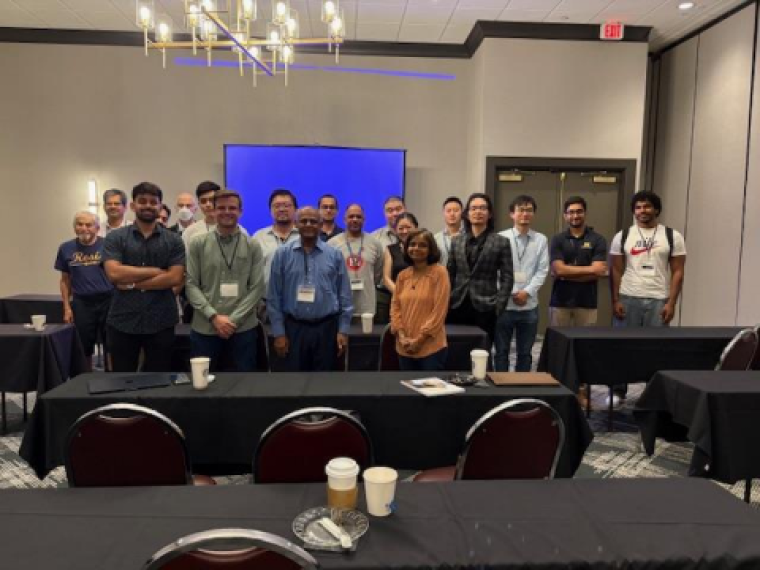
This workshop, supported by CASS as a Satellite Workshop at MWSCAS 2025, was a highly successful workshop. The workshop had 30-35 attendees. Quantum computing offers transformative potential across fields like AI, optimization, and wireless communications by enabling exponential speedups over classical methods. However, challenges such as qubit noise, hardware limitations, and error correction remain significant barriers. This workshop explores advances in quantum machine learning and system architectures that aim to bridge the gap between current capabilities and real-world quantum applications. Four expert talks highlighted progress and opportunities in integrating quantum technologies into next-generation computing and network systems. Four students presented their unpublished research, providing additional opportunities for discussion and engagement.
Invited Presentations:
Keshab K. Parhi | Dept. of Electrical & Computer Eng.
University of Minnesota Twin Cities | Minneapolis, MN
Abstract: This talk will provide an overview of quantum error correcting codes (ECCs) and describe the developments of Calderbank-Shor-Steane (CSS) codes, and their quantum circuit optimizations. Specific topics include: (a) Introduction to quantum gates and circuits, (b) Shor’s 9-qubit ECC and stabilizer formalism for quantum ECCs: bit-flip and phase-flip codes, (c) Systematic method for construction of quantum ECC circuits: encoder, syndrome generator, and decoder circuits, (d) Optimization of quantum ECC circuits in terms of number of multiple-qubit gates: circuit equivalence rules and matrix equivalence, and (e) Nearest neighbor compliant (NNC) quantum ECC circuits.
Quantum Machine Learning: Bridging Quantum Computing and Artificial Intelligence
Samuel Yen-Chi Chen | Lead Research Scientist, Wells Fargo
Abstract: Quantum Machine Learning (QML) stands at the cutting edge of computational intelligence, integrating quantum computing with classical machine learning to tackle complex problems beyond the reach of conventional methods. This talk will examine how QML harnesses quantum mechanical principles — including superposition, entanglement, and interference — to enable novel learning paradigms. Special emphasis will be placed on variational quantum circuits (VQCs) as a core building block for designing QML models on noisy intermediate-scale quantum (NISQ) hardware. In addition, we will introduce emerging techniques in Quantum Architecture Search (QAS), which automate the discovery and optimization of quantum circuit structures tailored for specific learning tasks. Drawing on our latest research, we will showcase
applications where QML and QAS synergistically advance performance across multiple domains. The presentation will conclude by discussing the mutual reinforcement between artificial intelligence and quantum computing, outlining both the opportunities and key challenges that shape the future of QML.
Building a Hybrid Quantum-Classical Computing Ecosystem
Gokul Ravi | Computer Science & Engineering
University of Michigan | Ann Arbor, MI
Abstract: Quantum computing (QC) is a transformative technology with the potential to revolutionize computing. Despite major theoretical and experimental progress over the past three decades, a significant gap remains between the demands of quantum applications and the capabilities of current hardware. QC still faces major challenges in delivering accurate, efficient solutions to real-world problems. The quantum ecosystem is inherently hybrid, with quantum devices tightly coupled to classical hardware and software. Advancing these components in a synergistic manner is essential to bridging this need-capability gap and enabling a practical quantum future. As the field continues to grow, substantial progress is needed at the quantum classical interface, including: (a) scalable software for executing real-world applications on noisy devices, (b) low-cost, efficient classical hardware with minimal latency and bandwidth limitations for scaling up quantum processing, and (c) a smooth transition path from noisy devices to fault-tolerant systems. In this talk, I will highlight several examples of our research addressing these challenges.
Quantum and Quantum-Inspired Computation for NextG Wireless Baseband Processing
Prof. Kyle Jamieson
Princeton University
Abstract: For wireless network designers, user demand for increasing amounts of capacity continues to outpace supply, and while 5G has made progress, even higher-performance remains impractical in part because baseband algorithms are extremely computationally demanding: there is elasticity in the relationship between spectral efficiency and expended compute cycles. This line of work aims to transform the current research landscape by leveraging quantum computation to overcome previous computational limitations, enabling new levels of wireless network performance, with the eventual outcome of incorporating quantum computation into tomorrow's Next Generation standards. We have implemented a series of such designs on quantum annealer and gate model computers: I will touch on a Large MIMO detector, an LDPC decoder, and work on a Polar code decoder. Our experiments evaluate these systems on real and synthetic channel traces, showing that 30 μs of compute time can enable 48 user, 48 AP antenna BPSK MIMO detection at 20 dB SNR with a bit error rate of 10E-6. For LDPC decoding, our quantum decoder achieves a performance improvement over an FPGA based soft belief propagation LDPC decoder, by reaching a bit error rate of 10E−8 and a frame error rate of 10E-6 at an SNR gap of up to 3.5 dB. I will conclude with a roadmap for future progress in this area.
Four students presented their recent research results. These presentations are listed below:
1. Dhanvi Bharadwaj and Gokul Ravi, University of Michigan, Clifford Initialization for the Quantum Approximate Optimization Algorithm
2. Alexander Knapen, Guanchen Tao, Jacob Mack, Mehdi Saligane, Dennis Sylvester, Qirui Zhang, and Gokul Ravi, University of Michigan, A Cryo-CMOS Pre-Processing Architecture for Quantum Error Correction Decoding
3. Aditya Sodhani and Keshab K. Parhi, University of Minnesota Twin Cities, Efficient Encoder/Decoder Circuits for Non Binary Quantum Error Correction Codes
4. Hao Li and Bibhu Datta Sahoo, University at Buffalo, Digitally Intensive Ring-VCO Based Quantum Algorithm Emulation
The talk slides were distributed to all attendees. We believe the workshop was very successful.